For recent Carroll College graduate Jack Conway, a classroom research project evolved into an international opportunity that few undergraduate students ever experience.
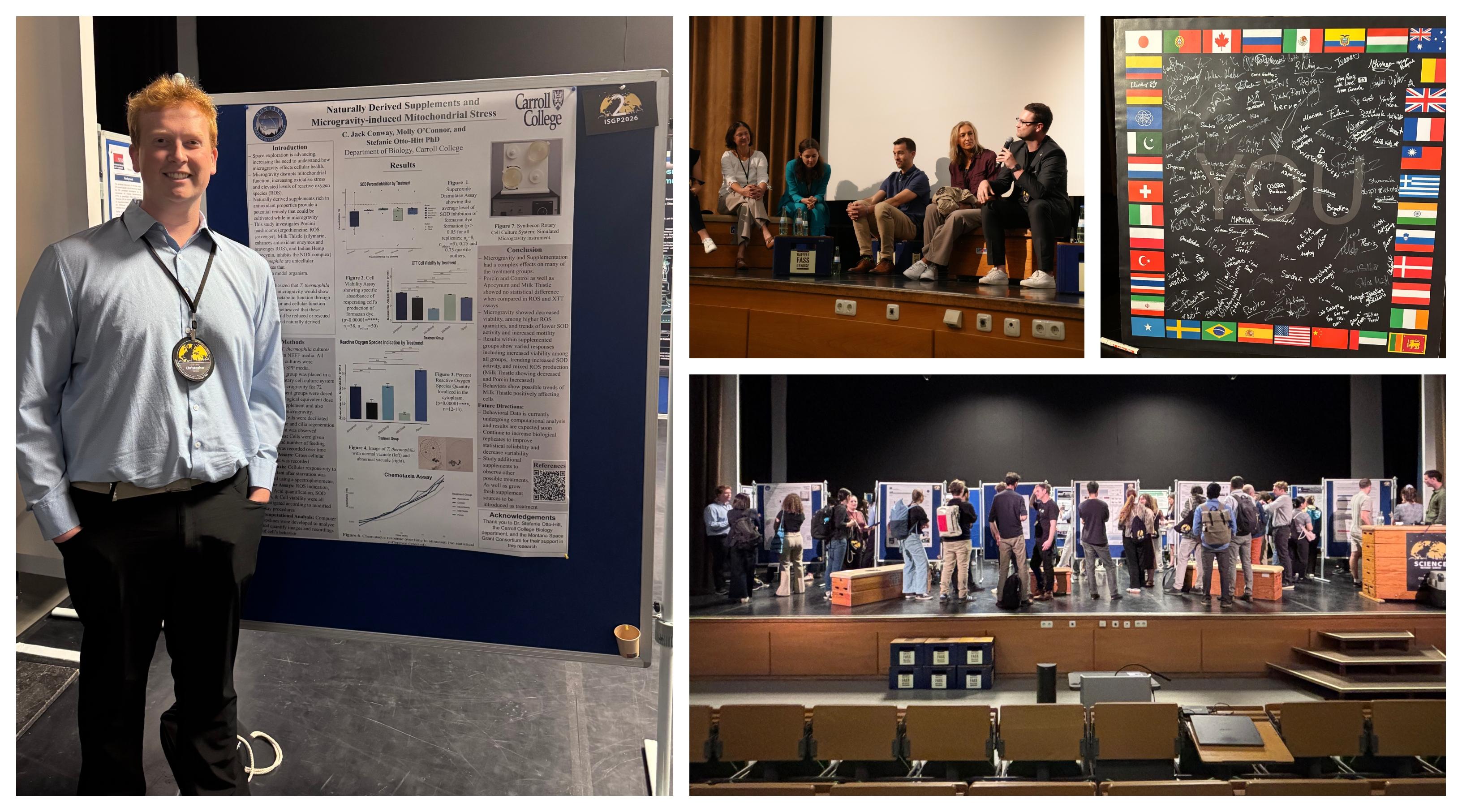
In May, Conway traveled to Cologne, Germany, to present his research at the International Society for Gravitational Physiology Conference, a gathering of scientists, researchers, and students from around the world focused on the biological effects of gravity and spaceflight. His poster presentation was accepted for the conference, an uncommon achievement for research conducted entirely at the undergraduate level.
Conway's research examines the mitochondrial and metabolic stress experienced by cells in microgravity and explores natural supplements that may help mitigate these negative effects. The long-term goal is to identify compounds from plants or fungi that astronauts could potentially grow during extended space missions to help counteract oxidative stress and support cellular health. As human space exploration continues to expand, understanding and addressing the health challenges associated with long-duration spaceflight becomes increasingly important.
The project began through the Advanced Research Experience (ARE) in Molecular Biology under the mentorship of Associate Professor of Biology Dr. Stefanie Otto-Hitt. With her guidance, Conway secured funding from the Montana Space Grant Consortium (MSGC) to continue the research as a summer apprentice. The project expanded throughout the academic year, leading to an additional apprenticeship and a successful joint application for a $15,000 MSGC Research Startup Grant to support ongoing research efforts.
As his work progressed, Conway had opportunities to share his findings beyond campus. He traveled to Washington, D.C., for the National Space Grant Meeting, where he discussed his research with members of Montana's congressional delegation and their staff, highlighting the value of undergraduate research and the role of programs such as Space Grant in supporting future scientists.
Conway also presented at the Space Grant Research Festival alongside fellow MSGC apprentice and Carroll student Molly O'Connor, who contributed to the project as a computer and data scientist. Seeking additional opportunities to share their work, Conway submitted an abstract to the International Society for Gravitational Physiology Conference. His presentation was accepted, and he was awarded the William A. Hiscock Space Grant Award from MSGC, which funded his travel and participation.
Following Carroll College's Rome Pilgrimage, Conway traveled to Cologne from May 24–29 to attend the conference. There, he presented his research, networked with scientists and graduate students from around the world, and attended presentations by industry leaders, government researchers, and current and former astronauts.
As one of the few conference participants who had not yet begun graduate-level research, Conway represented both Carroll College and undergraduate scholarship on an international stage.
“Being able to attend an international conference and share my research on a global scale was such an amazing experience. I was able to discuss my work and ideas with scientists from around the world and gain amazing connections and insights. I am very grateful to Carroll, Dr. Stefanie Otto-Hitt, and the Montana Space Grant Consortium with the award of the William A. Hiscock Space Grant award for making all of it possible!”
Conway's experience reflects the opportunities available to Carroll students through faculty mentorship, undergraduate research, and partnerships with organizations such as the Montana Space Grant Consortium. What began as an idea in a molecular biology research course ultimately led to an opportunity to contribute to an international scientific conversation about the future of human space exploration.