In an effort to expand outreach and cultural understanding, Carroll College students and faculty are creating new opportunities to learn from and collaborate with Montana’s Native American communities. Two recent initiatives highlight this ongoing work.
Catholic Studies Program: Immersion, Inquiry, and Relationship-Building
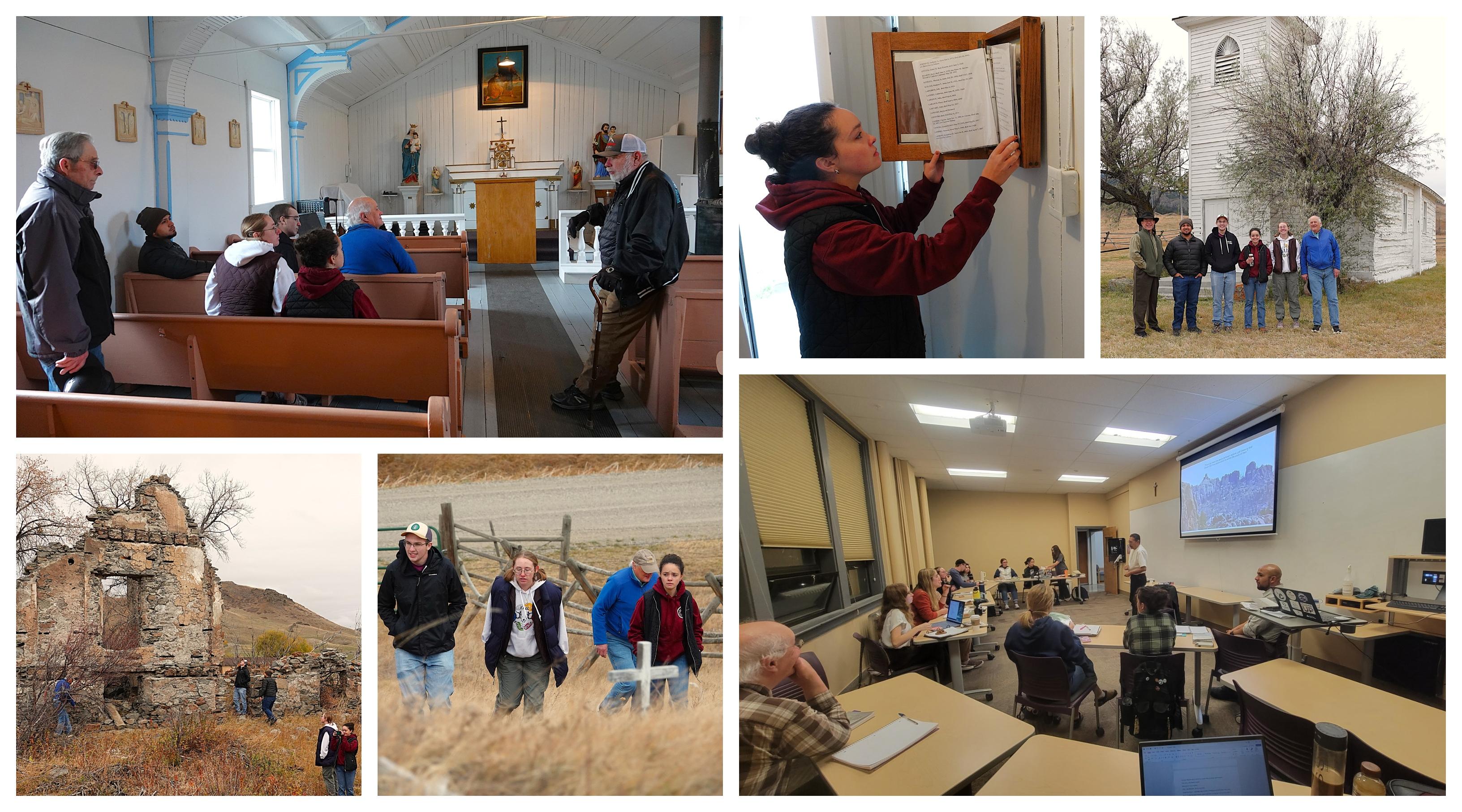
Students in Carroll's Catholic Studies Program are completing a formative semester in CATH 308: The American West and the Catholic Imagination, taught by Dr. Joseph Esparza. Students in the course have been deeply immersed in the challenging and complex history of faith and culture in Montana. Covering the moral legacy of freedom and responsibility in the West, the Catholic history of the region, and the intricate tapestry of Native-Catholic relations, the class sought to think about the past and live out their faith in bold action. Earlier in the semester, the students spent a day in the Diocese of Helena archives, pouring over primary sources, sermons, photos, and letters related to the Church's ministry to Native peoples. They wrestled with the entangled themes of reconciliation, colonialism, and evangelization as they related to the Church's ministry and its relationship with the U.S. government.
A key experiential component of the course, partially funded by the Justice Outreach Program at the Diocese of Helena, was a day-long field trip dedicated to cultural immersion, ministry, and evangelization on the Blackfeet Reservation. Leaving at 6:45 a.m., the students embarked on a journey to sites historically connected with the Blackfeet Nation and Montana's wider Catholic history. Their first stop was Saint Peter's Mission (1874), which once housed an integrated Native and settler boarding school. Next, they toured the Ursuline Center in Great Falls (1912), a school to many Native children from across the West during the boarding school era, where they learned about the complicated relationships between the Native students and the Ursuline sisters. Finally, they traveled to the Blackfeet Reservation itself, visiting and touring Holy Family Mission and School (1886), originally founded with financial contributions by Saint Katherine Drexel. There, the group was guided by the LaSalle Brothers, with Brother Dale Mooney offering a wealth of historical knowledge and theological insights. Throughout the day, the students put their learning and faith into action, praying and listening at these historically significant places.
Students expressed how these encounters shaped their understanding. Reflecting on the difficult history of Native boarding schools, junior Nolan Forseth of Fairfield, MT, shared, “Not only has this class been really good for learning about the teachings of the Catholic church and how they apply to the history of the west, but we have been able to get a fuller story on different controversial topics. For example, on the trip we took there were a ton of gifts from the native families that were given to the teachers at one of the schools.” His observation highlights how these gifts, offered by Native families to the sisters, complicate the broader narrative.
Junior Maggie Toeckes of Power, MT, reflected on the spiritual impact of the course and experiential learning opportunities, “The Catholic Studies program has been instrumental in helping me grow in my understanding of what it truly means to live in the world but not of the world as a Catholic rooted in the faith. This field trip only strengthened that lesson as we learned about the courage of the early Ursuline sisters and Jesuit brothers bringing the faith to Montana. While their courage in the face of so much adversity is admirable their story isn't perfect just as ours today isn't perfect. The Church is and always has been made up of sinners in need of Christ's mercy. I'm just so grateful to see how the Lord has been at work in the midst of the mess right here in Montana.”
Earlier in the semester, Moose Edwards, a Diocese of Helena Deacon-Candidate and Blackfeet Tribal Member, made the generous drive down from the Blackfeet Reservation to speak with the class. Before his arrival, students discussed the life and importance of Servant of God Nicholas Black Elk (Oglala Lakota Sioux) and the radiant beauty God brings through redemptive suffering in history. After offering Mr. Edwards a variety of class-made gifts and baked goods, the students were captivated by his personal story of faith in action. Moose shared his profound conversion story and the reality of his daily encounter with Christ on the Blackfeet Reservation. The discussion quickly turned open and honest, focusing on the difficulties the Church is striving to address within the Blackfeet Nation, including the pressing issues of access to the Sacraments, Catechesis, and the essential care for the poor, sick, and marginalized. He also engaged the students on the sensitive topic of discerning an orthodox inculturation of Native traditions.
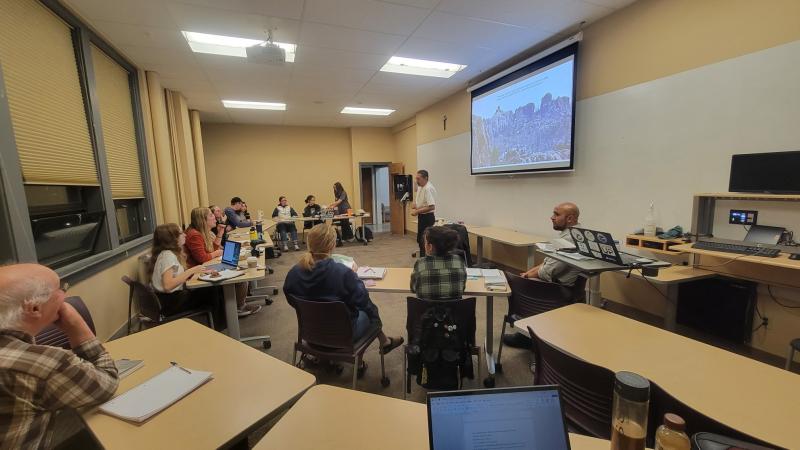
Moose Edwards' life is a testament to active faith: he is an EMT, is involved in motorcycle ministry, offers pastoral and spiritual counseling to those poor in body and spirit, and regularly preaches in mission parishes without an assigned priest, where he offers communion services with the permission of the reservation priest. He is currently discerning a future in which he will be ordained a permanent deacon for the Diocese of Helena in 2027.
Through classroom study, archival research, and personal encounters, the Catholic Studies program continues to deepen students’ understanding of the intertwined histories of Native communities and the Catholic Church, inspiring thoughtful dialogue and faith-informed engagement.
Communication Center Podcast Collaboration with Chief Dull Knife College
Carroll’s commitment to engaging with Native communities also extends to collaborative projects in communication and storytelling. As part of the Carroll College Communication Center in the Simperman Learning Commons, the podcast studio has become a hub for building partnerships with tribal colleges.
Over fall break, Dr. Alan Hansen, Director of the Communication Center, and Rachel Martin, Academic Instructional Technologist, visited Chief Dull Knife College in Lame Deer, Montana. Their visit focused on supporting efforts to integrate podcasting and multimedia tools into Cheyenne language instruction and other academic programs.
Alan and Rachel met with CDKC faculty to discuss how audio and video storytelling can support cultural preservation, expand teaching methods, and empower students to share their voices. They also installed podcasting equipment for faculty and students to test, opening new possibilities for locally created content and student-led storytelling.
During the visit, Rachel offered a faculty-wide presentation on the opportunities and challenges surrounding artificial intelligence in academic settings. Both she and Dr. Hansen hope this is the beginning of a sustained collaboration, one that may include joint podcasting projects between Carroll and CDKC students.
Carroll College remains committed to building authentic partnerships with Native American communities, grounded in mutual learning, humility, and respect. Through academic exploration, cultural immersion, and creative collaboration, these initiatives reflect Carroll’s broader mission to serve the common good while honoring the diverse histories and identities that shape Montana.