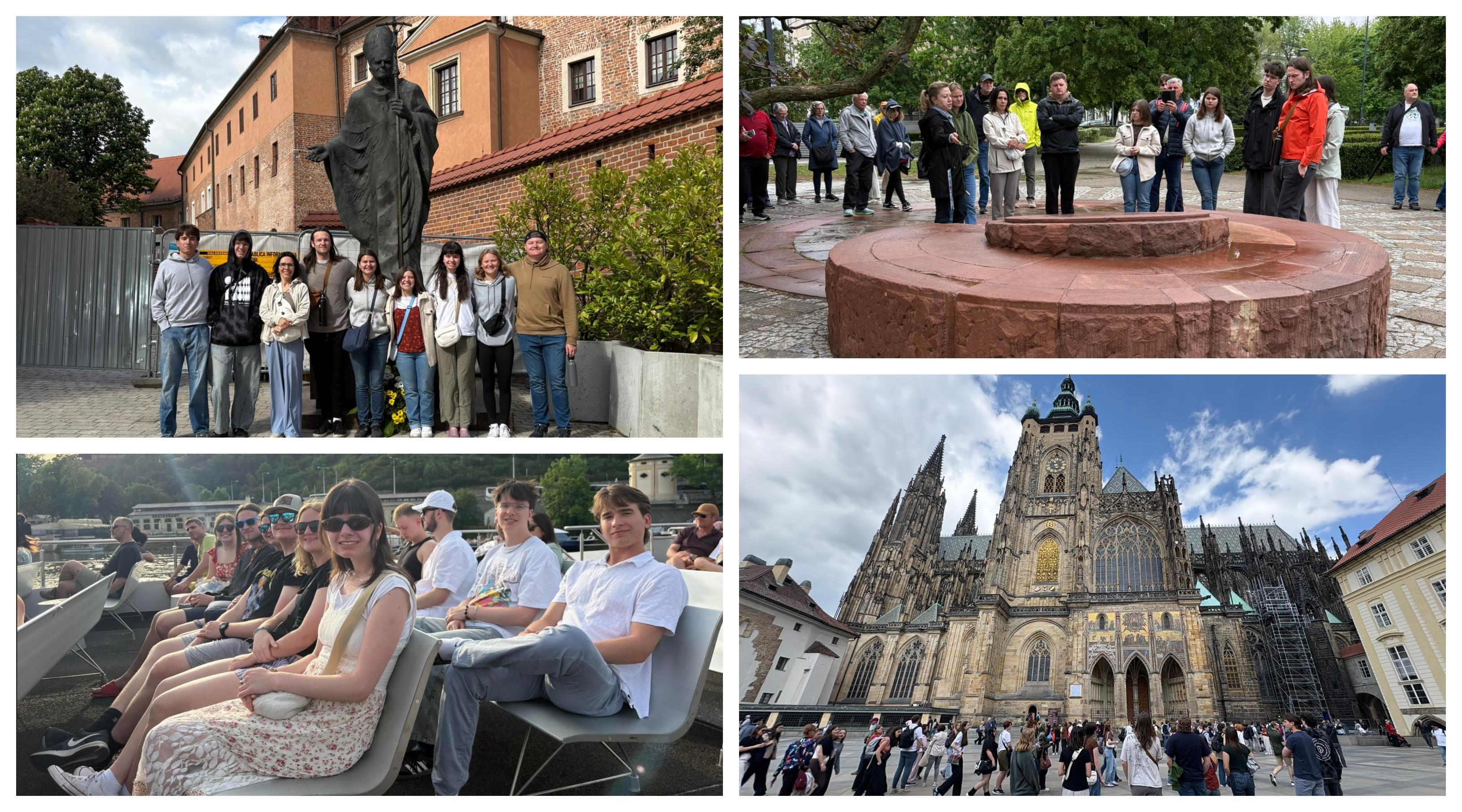
Photos clockwise: The travelers at the statue of St. Pope John Paul II on Wawel Hill, Krakow; Holocaust memorial, Warsaw; Medieval Long Market, Gdansk; Cruising the Vitava, Prague
Ten Carroll travelers, including six students, spent two weeks exploring the history, culture, and people of Poland and the Czech Republic this May. Professor of History Dr. Jeanette Fregulia reflects on the experience and the lasting lessons it provided.
At the Crossroads – Poland and the Czech Republic
Fittingly, it was a grey and rainy morning as Carroll College in Poland and the Czech Republic stood at the gates of Auschwitz-Birkenau, just over an hours drive from Krakow, Poland, in the town of Oswiecim. In three and one-half hours, years of history found, for many, only in books and lessons leapt off the page and out of the classroom. Words and pictures are inadequate. The call to bear witness to the suffering of millions, however, is an imperative.
As one of the students wrote later, “seek out life’s hidden lessons everywhere,” a clarion call to heed the atrocities of the past.
As necessary, and intentionally first, as the experience just described was, in planning for fourteen days in these two Eastern European countries (May 11 – 25, 2026), I wanted the students to know more about them than the horrors of Nazism and then Communism. What follows is a smattering of all we saw, did, and learned.
In search of Poland’s rich and storied past, our time in Krakow included the famed Wawel Hill, Castle, and Cathedral, a salt mine tour, and a cooking class where we made, and ate, pierogi. Our next stop, Poland’s capital Warsaw, meant the Palace of King Jan III, a tour and tasting at a vodka museum, a walking lesson around the Old Town, and some time with the peacocks at the Lazienki Royal Park, whose beautiful grounds offered the perfect respite.
"Wow, just wow."
Our time in Poland ended with Gdansk, with it’s shipyard, the birthplace of the Solidarity Movement founded in 1980 by Lech Walesa. From the medieval Long Street/Long Market to a concert at the Cistercian Abbey in the charming town of Oliwa to Westerplatte, where Hitler invaded Poland in 1939. While with Hitler came terror and suffering, and even more powerful force left Poland, bringing hope and compassion to the wider world. Indeed, no matter where we went in Poland it was possible to feel the presence of Pope St. John Paul II, his hand gently guiding us.
"A truly eye-opening experience."
When people ask which of the past five studies abroad that I have led was the best, my honest response is always “I love all of my children equally.” While that remains true, our time in Poland was uniquely moving. The mother of one of our Carroll travelers was born and raised in Warsaw. She left the country thirty-seven years ago, and until last May had not been back. Together with her daughter (the Carroll student), and two sons, she gave us a glimpse into what her life had been like, showed us the apartment where she lived, and was our cultural and language expert – an indescribable blessing and grace.
A long train ride from Gdansk ended in Czechia’s capital, Prague. During our time there was, of course, a stunning castle, some amazing art, and many places of worship. Known for it’s connections to legends, underground dungeons, and ghosts, one evening included a nighttime tour of this eerie history, including the revelation that right under our feet was a huge cemetery for victims of the Plague of the late fourteenth century. An excursion of the famous Pilsner Urquell Beer brewery, a morning at the new Museum of Communism, a boat cruise on the Vitava River, another cooking class, and a final dinner at a medieval tavern (including a show) illustrated why Prague remains a destination for so many.
As is always true, there was time for the students to explore on their own, for us all to support the local economy (shop), and for me to reflect yet again on the hope I feel from being a small part of the lives of our students in a very special way. It’s humbling really, an undeserved grace, to watch the transformations that occur in even just two weeks away from all that is familiar and safe.
As we traversed the history of Poland and the Czech Republic, from the ugly to the beautiful, the recurring theme was of people and places that have endured, and even thrived, leaving us in awe of the true indomitability of the human spirit.
I close with these words of wisdom from one of the students, “hope will cast out darkness.”
~ submitted by Jeanette Fregulia, Ph.D., Professor of History